Feistel Cipher
Feistel cipher 是一種重要的 block cipher 結構。其核心做法是先把輸入區塊分成左右兩半,然後重複進行多輪更新。若第 $i-1$ 輪的輸入為 $(L_{i-1}, R_{i-1})$,第 $i$ 輪定義為
\[L_i = R_{i-1}, \qquad R_i = L_{i-1} \oplus F(K_i, R_{i-1}).\]其中 $K_i$ 是第 $i$ 輪 round key,$F$ 是 round function。這種結構的重要特徵在於:即使 $F$ 本身不可逆,整個 round 仍然可逆。
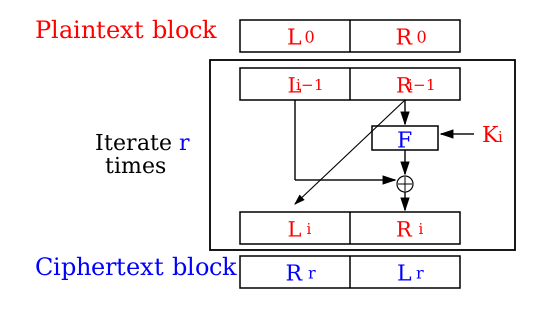
Encryption and Decryption
Encryption
\[\begin{aligned} L_i &= R_{i-1} \\ R_i &= L_{i-1} \oplus F(K_i, R_{i-1}) \end{aligned}\]Decryption
\[\begin{aligned} R_{i-1} &= L_i \\ L_{i-1} &= R_i \oplus F(K_i, L_i) \end{aligned}\]Round Invertibility
Feistel 結構的可逆性可以直接由 round update 式子看出。已知
\[L_i = R_{i-1}, \qquad R_i = L_{i-1} \oplus F(K_i, R_{i-1}),\]則可由 $L_i = R_{i-1}$ 得到
\[R_{i-1} = L_i.\]再代回第二式:
\[R_i = L_{i-1} \oplus F(K_i, L_i).\]因此
\[L_{i-1} = R_i \oplus F(K_i, L_i).\]所以解密可寫成
\[R_{i-1} = L_i, \qquad L_{i-1} = R_i \oplus F(K_i, L_i).\]這表示只要 round key 已知,就能逐輪反向還原先前狀態。
Properties
Design Advantage
Feistel cipher 有兩個直接的設計優點。
- $F$ 可以是任意函數,而不需要先保證其本身可逆,仍然能得到可逆的加密結構。
choose any function $F$, yet still obtain an invertible encryption function which can be inverted using the secret key
- 加密與解密可以共用相同的程式或電路,只需要在解密時將 round key 的使用順序反過來即可。
the same code or circuitry can be used for encryption and decryption functions, with only the order of the round keys reversed for decryption
這使得 Feistel 結構在硬體與實作上都很自然,也成為經典 block cipher 設計的重要形式。
Security Considerations
Feistel 結構本身只保證可逆,並不自動保證安全。實際安全性仍取決於下列因素:
- round keys 如何由主金鑰產生
how the round keys are generated from the main key
- 總共使用多少 rounds
how many rounds are used
- 函數 $F$ 的設計方式
how the function $F$ is defined
若這些部分設計不佳,即使採用 Feistel 結構,仍可能被攻破。
Feistel Cipher as an Iterated Block Cipher
許多 block ciphers 透過 repeated rounds 來累積安全性。Feistel cipher 就是一種典型的 iterated block cipher:每一輪只做簡單操作,但在多輪反覆作用下,逐步增強 substitution、permutation 與 key mixing 的整體效果。
Relation to DES
DES 是 Feistel cipher 的一個具代表性的變形。它沿用左右半部交替更新的結構,並透過 16 輪 round、round key schedule,以及額外的 permutation 與 substitution 元件來建立實際的加密演算法。Feistel 結構提供了 DES 的骨架,而 DES 的安全性則進一步依賴其 $F$ 函數與整體參數設計。
- the number of rounds $r$ is 16
- the block length $n$ is 64 bits
- the key length is 56 bits
- the round keys $K_1, \dots, K_{16}$ are each 48 bits
References
- Nigel P. Smart, Cryptography: An Introduction (3rd ed.), Chapter 8. PDF